> For the complete documentation index, see [llms.txt](https://docs.clouddley.com/llms.txt). Markdown versions of documentation pages are available by appending `.md` to page URLs; this page is available as [Markdown](https://docs.clouddley.com/apps/extras/custom-domain.md).
# Custom Domain
Custom Domain for Apps on Clouddley.
Setting up a custom domain enhances accessibility for users and improves your brand’s identity.
{% hint style="info" %}
Clouddley uses [Google Cloud Armor](https://cloud.google.com/armor/docs/cloud-armor-overview#:~:text=Google%20Cloud%20Armor%20helps%20you,and%20SQL%20injection%20\(SQLi\).) in the background to protect your custom domain from distributed denial-of-service (DDoS) and other web-based attacks. It filters and routes all traffic through Google’s Load Balancer, ensuring that only legitimate requests reach your application.
{% endhint %}
To set up your custom domain on Clouddley, follow these instructions:
1. Navigate to **Apps** and select your **app.**
2. On the App dashboard, select **Custom Domain** and click on **+ Add Custom Domain.**
Custom domain overview page
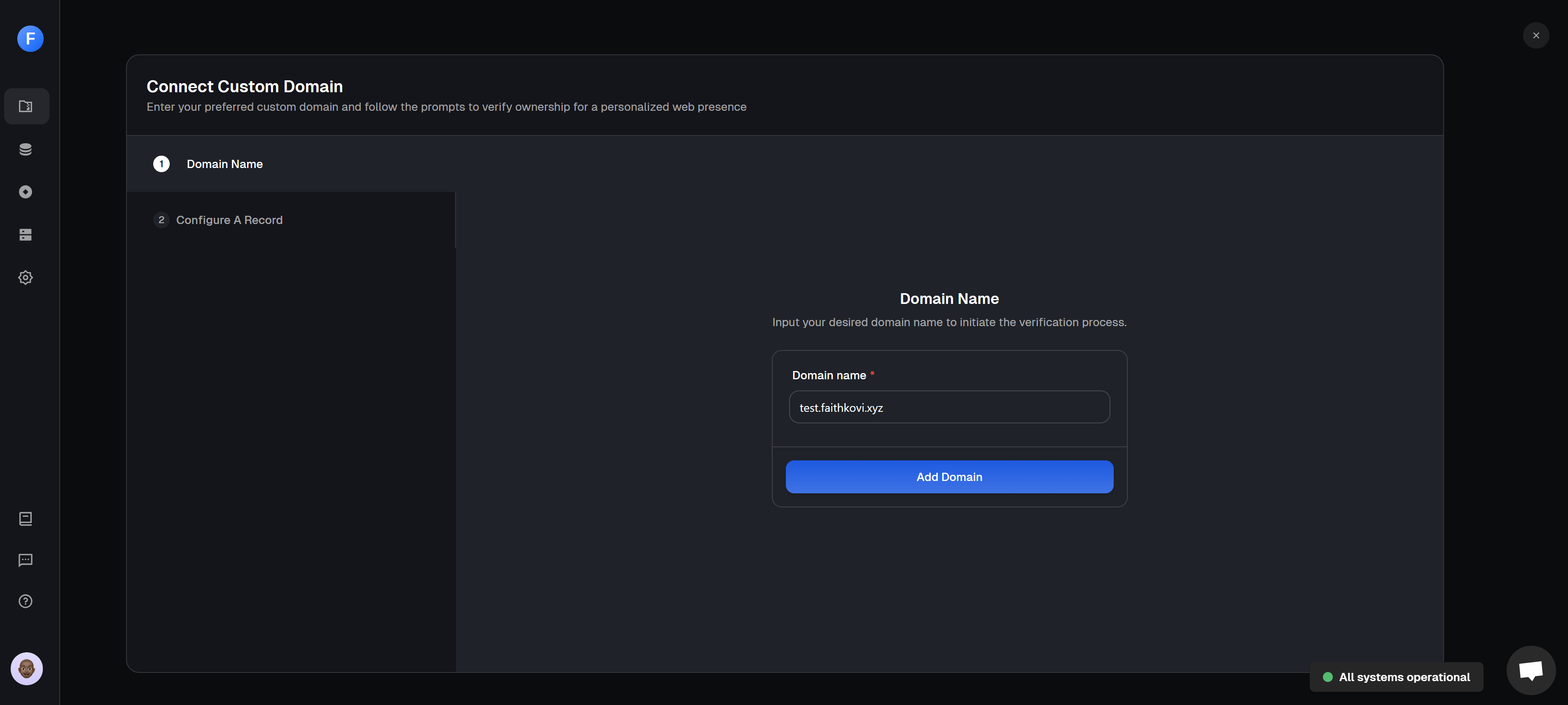
3. Enter the **name** of your domain and click on **Add Domain.**
Adding a domain name to setup custom domain
4. Follow the instructions provided to configure a **DNS Record.**
Configuring a Record for the domain
5. After DNS propagation, the custom domain is **verified**. To make it a default domain, turn on **Set as default domain**.
Your application is now connected to a custom domain.
Custom domain set up successfully
You can add multiple custom domains to your application and set one as the default.